
What Adept Delivers
Complete engineering solutions — from core design through specialist coordination
Engineering Design
Adept provides senior-level engineering support from initial concept through production-ready documentation. Whether the engagement calls for team augmentation or full engineering scope ownership — new development, redesign, or projects requiring a fresh direction — the deliverable is always the same: a technically sound, fully documented design solution ready for the next phase of the project.
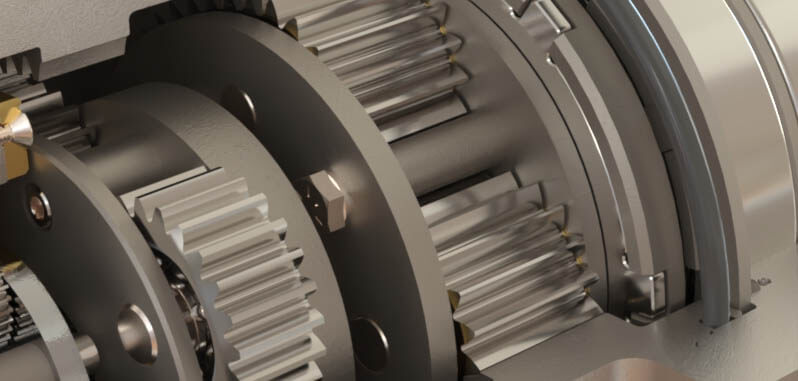
Every engineering project begins with a problem to be solved. Adept’s role is to ensure the engineering solution addresses that problem precisely — from the definition of requirements through to a fully documented design ready for the next phase of the project.
The strongest engineering outcomes come from engaging the engineering process correctly from the start — requirements defined, constraints understood, and the design developed from a sound foundation. Where a project arrives at Adept at a later stage, that same discipline is applied: understanding what the design must do, assessing what it is doing, and determining the most direct path to a solution that performs.
Every Adept design engagement ends at the same place: a technically sound, fully documented design solution that the next phase of the project can build on.
There are engineers with thirty years of experience doing the same thing, and there are engineers with thirty years of experience doing many things, these are two very different engineers.— Henry Villaume, PhD
- Concept feasibility amd development
- Mechanical systems layout and detailed design
- Stackups, tolerance analysis and GD&T per ASME Y14.5
- Design for manufacture and Assembly
- Production Ready engineering drawings and documentation
- Independent senior level engineering and checking
Analysis & Simulation
Engineering analysis is embedded in every Adept engagement — project demands met with analytical rigour from first principles to advanced simulation, applied with the judgement that comes from knowing not just how to analyse, but what to analyse, and when the analysis is correct.
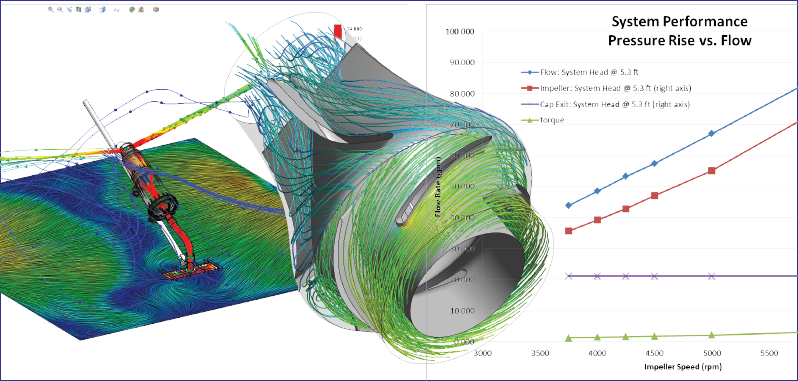
Adept’s analytical practice has developed over four decades, beginning at a time when finite element analysis required its own dedicated team and the geometric models fed into it were defined practically node by node, with results delivered as reams of dot matrix printouts. That foundation — and the depth of experience it produced — shaped an approach to analysis that treats FEA not as a software function but as a tool to effectively embrace the engineering discipline behind it. The tools have changed dramatically. The principles have not.
Static structural analysis is performed in-house, integrated with the 3D design process as a continuous check on the design rather than a formal exercise at the end of it. Hand calculations remain an integral part of that process — not as an alternative to simulation but as the engineering foundation that makes simulation meaningful. A result that cannot be validated against first principles is a result that cannot be trusted. The fundamental question behind every analysis, regardless of how sophisticated the tool that produced it, is the simplest one: does it make sense? Answering that question correctly requires a firm grounding in engineering fundamentals that no software can substitute for.
Where the analysis extends into higher-order disciplines — computational fluid dynamics, vibration, thermal, and dynamic simulation — Adept engages specialist firms whose primary practice is in those specific domains. This is not a limitation; it is a deliberate model. A CFD analyst who performs fluid analysis daily brings a depth of domain knowledge to the problem that a generalist tool cannot replicate. What Adept provides in these engagements is the engineering judgment that the specialist cannot — defining the scope of the analysis correctly, identifying the right boundary conditions and load cases, and interpreting the results in the context of the design. An analysis scoped by the analyst tends to answer the wrong question with precision. An analysis scoped by the design engineer answers the question that actually matters.
The result is an analytical framework that scales to whatever the project requires — from a first-principles hand calculation to a multi-discipline simulation program — without ever losing the thread between the analysis and the design it serves.
Prototype Development
Prototype development at Adept is driven by the project requirements — method, fidelity, and build approach selected to confirm precisely what the design needs to demonstrate at each stage of development.
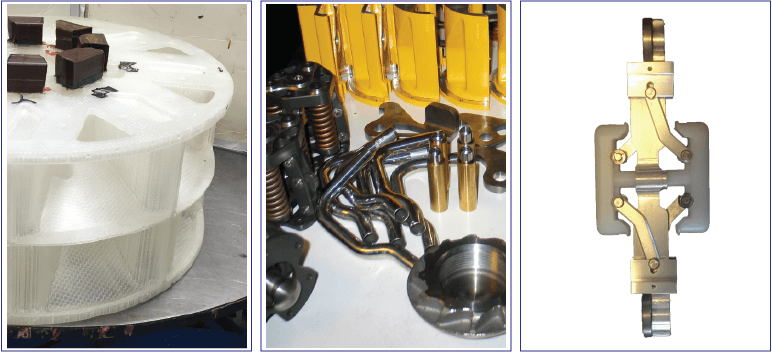
The first prototype is virtual. A 3D solid model gives the engineer interference and clearance checking, mass properties, and geometry that drives directly into simulation — putting the full range of simulation and physical prototyping methods within reach from the earliest stage of design.
The recurring decision from there is whether a question gets answered in simulation or on the bench. Adept makes that call stage by stage, weighing cost, schedule, and what each path can actually confirm — committing to a physical build only where simulation can’t close the question, or where the program needs a physical result to move forward. Forty years across defense, aerospace, and industrial programs, plus the analysis specialists Adept regularly engages, means that call is informed by having run both paths enough times to know where each one holds up and where it doesn’t.
A further distinction shapes every build: a one-off prototype, a small batch, and full production are often different design problems, not the same design at different volumes. Before fabrication method is chosen, Adept establishes what the client’s objective actually is — proving a concept, attracting investment, validating before tooling, or moving straight to production — because that objective, not habit or convenience, determines how the design and the build are approached.
Where a design carries several unproven elements at once, each is isolated and evaluated independently before being committed to an integrated build. This keeps the variables at each stage manageable and avoids finding a subsystem problem buried inside a fully assembled prototype — a lesson better learned early than late.
Fabrication method and fidelity then track the question being answered and the volumes in view: additive processes, machined components, or representative sub-scale builds, selected on the same basis that will govern production. Tolerance analysis precedes the build, so results are dimensionally meaningful from the first article rather than requiring rework before they’re usable.
Each stage moves the design measurably toward the client’s actual objective, with results feeding the next iteration directly and production release following once the prototype has demonstrated what it set out to show.
- FDM/FFF 3D printing — form and basic clearance checks, low-load fixtures & brackets; qty 1–10; hours–days
- SLA/DLP resin printing — high-detail visual/form prototypes, fit checks; qty 1–20; hours–days
- SLS nylon printing — functional prototypes, snap-fits, light load-bearing parts; qty 1–50; days
- Metal additive (DMLS/SLM) — complex geometry, internal channels, lightweighting; qty 1–25; days–weeks
- CNC machining (3-axis) — precision metal/plastic parts, prototype to low-volume production; qty 1–50; days–weeks
- CNC machining (5-axis) — complex geometry, aerospace/defense components; qty 1–50; days–weeks
- Sheet metal fab (laser cut, brake form, weld) — enclosures, brackets, structural frames; qty 1–50; days–weeks
- Vacuum casting (urethane) — low-volume plastic parts mimicking injection molding; qty 10–100; 1–3 weeks
- Cast urethane/silicone tooling — bridge production for injection-molded parts; qty 10–100; 1–3 weeks
- Investment casting (rapid tooling) — metal parts, complex internal geometry, low-medium volume; qty 10–100; 3–6 weeks
- Composite layup (hand/vacuum bag) — lightweight structural panels, prototype composite components; qty 1–50; days–weeks
- Welded/fabricated steel structures — frames, structural assemblies, large machine bases; qty 1–50; days–weeks

Engineering Reach
Project demands are met through Adept’s broad engineering reach — the right expertise assembled, directed, and delivered as a single integrated engagement. Engaging specialists when and where the project requires, each selected for the specific challenge, coordinated under the same senior-level direction that drives the engineering from the first day of the engagement to the last.
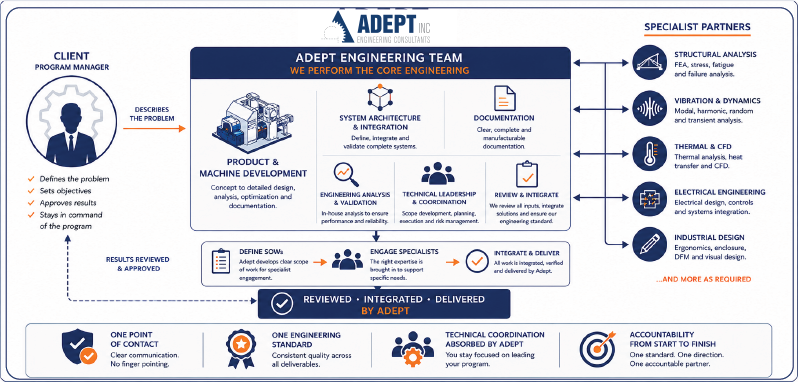
Adept’s network of specialist partners covers the disciplines that complex mechanical programs routinely require — structural analysis, vibration and dynamics, thermal and CFD, industrial design, and electrical engineering. When a program requires a specialist, the selection is made by an engineer with the cross-domain experience to evaluate technical competence directly — not by credential or proximity, but by the demonstrated ability to deliver the specific type of work the program needs.
What distinguishes this from a client managing a list of vendors is the engineering layer sitting above the specialists. A program manager running a complex mechanical development already carries the coordination burden — schedule, resources, deliverables, stakeholder reporting. Adept absorbs the technical coordination: preparing the scope of work for each specialist engagement, directing the work against that scope, and reviewing all outputs before they reach the program. The PM describes the problem. Adept produces the SOWs, manages the specialists against them, and delivers reviewed results for his approval. The program manager stays in command of the program. The engineering gets done to a standard that reflects well on everyone responsible for it.
This is not subcontracting. It is directed engineering. The difference is accountability: one point of contact, one engineering standard, one program direction from start to finish.

Defense & Aerospace

Industrial & OEM

Energy
The engineer defines the problem
The specialist solves it
The
Adept
model
Selected Projects
Engineering demonstrated, not described

Large Industrial Centrifuge
Complex rotating assembly: precision dynamic balancing, custom bearing configuration, continuous-duty drive system.

High-Capacity Linear Actuator
High-force linear actuation system — load analysis, mechanical design, and validation against performance and environmental requirements.

Hydro-Kinetic Turbine Rotor Hub
High-load rotating component for a submerged tidal energy system — continuous operation, demanding fatigue and corrosion requirements.
Have an Adept engineer contact you
An engineer will be in touch within 24–48 hours